

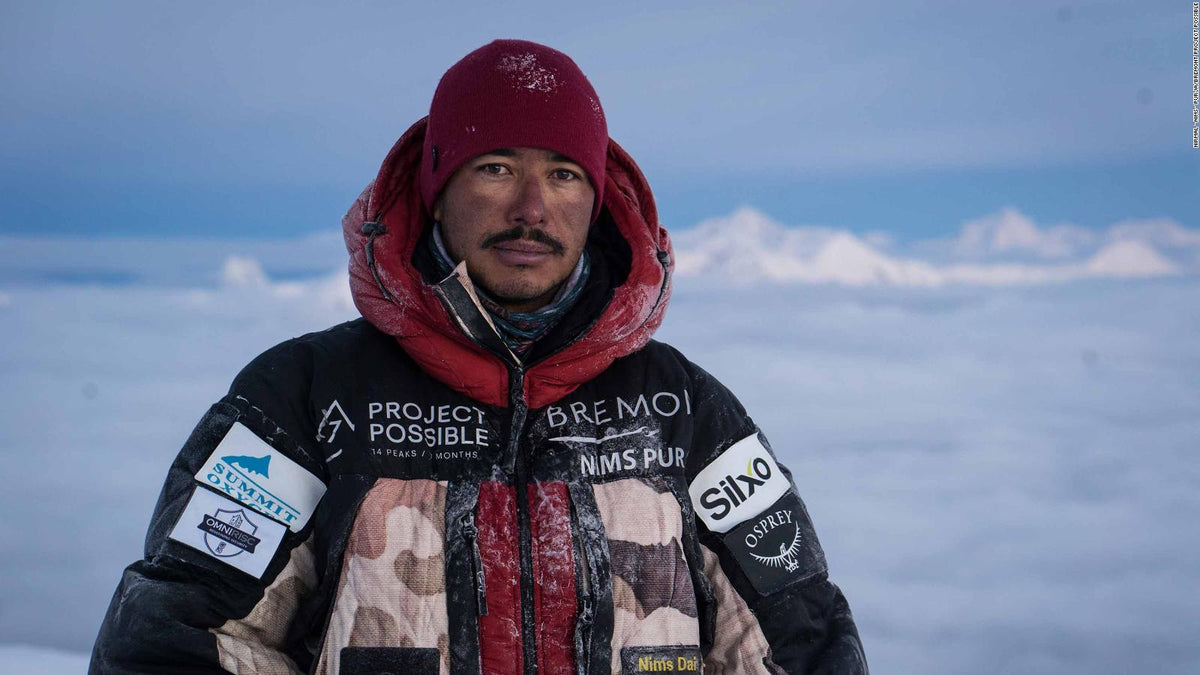
On July 30, 2026, an avalanche on Broad Peak in Pakistan's Karakoram range took the lives of ten climbers. One of them was Nirmal Purja. The world knew him as Nims. He was 43.
There will be a thousand obituaries this week. Most will list his climbs. This is not that.
This is about what he believed, and why what he believed matters more now that he is gone than it did while he was alive.

The math nobody wanted to do
In 2019, Nims announced he would climb all fourteen mountains on Earth taller than 8,000 metres in seven months. The climbing world laughed at him quietly, and then some of them laughed loudly.
The reason the laughter felt safe was arithmetic. The previous record for climbing all fourteen was held by Jerzy Kukuczka. It took him just under eight years. Reinhold Messner, the first person to do it, took sixteen. Nims was proposing to compress a lifetime of climbing into two seasons.
He finished in six months and six days.
The lesson people take from this is usually the wrong one. They say he proved that anything is possible. That is a bumper sticker. What he actually proved is more useful.
He proved that most of the limits we accept are not physical. They are inherited. Someone said this is how long it takes, and everyone after them agreed, and the number became a law of nature even though it was only ever a habit. Nims looked at the number and asked who wrote it. When he could not find a good answer, he ignored it.
You are living inside numbers other people wrote. How long a career takes. When you are allowed to start over. How much you are worth. Ask who wrote them.
He mortgaged his house
Project Possible cost around a million dollars. Nims did not have sponsors when he started. He had a stable career in the British Special Boat Service, the first Gurkha ever selected for that unit. He had a pension coming. He had a house.
He remortgaged the house. He left the pension on the table. He funded the first climbs with his own money and figured out the rest as he went.
Most of us wait for permission that never arrives. We wait for the sponsor, the promotion, the sign, the right time. Nims did not wait because he understood something quiet and hard: the person you are waiting for is you.
This is not a lesson about being reckless. He was one of the most calculated operators alive. It is a lesson about the difference between risk and cowardice dressed up as prudence. Sometimes those two look identical from the outside. Only you know which one you are choosing.
K2 in winter, and what he did on the summit
In January 2021, ten Nepali climbers stood on top of K2 in winter for the first time in history. K2 had been the last of the fourteen 8,000-metre peaks never climbed in winter. Every previous attempt had failed. Some had killed the people who tried.

Nims was one of the ten. He was faster than the others and could have summited alone and taken the record for himself. He did not. He waited about ten metres below the top, in air so thin and cold it can kill a person in minutes, so that the whole team could step onto the summit together.
They did it arm in arm, singing the Nepali national anthem.
For a century, Sherpas and Nepali climbers had done the hardest work on the highest mountains and watched foreign clients get the headlines. Nims used one of the biggest moments in mountaineering history to make sure the credit went home.
There is a version of ambition that is only about you. There is another version that lifts the people beside you as you rise. The second version is harder. It is also the only kind that lasts after you are gone.
What he refused to be
Nims was Nepali. He was British. He was a soldier and a climber and later a filmmaker and a businessman. Interviewers kept trying to make him pick one identity and stand still inside it. He refused every time.
He wore his Gurkha service with pride and refused to let anyone treat Nepali climbers as second-class. He built a company called Elite Exped and put Nepali guides at the centre of it. He made a Netflix film so his mother, who could not read, could see what her son had done.
He did not fit any of the categories the world offered him, so he built his own.
Most of us spend our lives trying to fit a shape someone drew before we were born. Nims spent his life proving that the shape is optional.
The last climb
He died leading his own expedition, on a mountain he chose, doing the thing he loved most, with people who loved him. He was not on someone else's payroll. He was not living someone else's plan.
That is not a tragedy in the ordinary sense of the word. It is a life that ended in the middle of itself, which is different from a life that ended in the middle of someone else's story.
The tragedy, if there is one, is for us. We lost a person who reminded us weekly that the ceiling we bumped into was probably painted on. He was going to keep reminding us for another forty years. Now he cannot, and the reminding is on us.

The question he leaves behind
Nims had a phrase he shouted before hard climbs. "Giddy up." Two words. He used them the way other people use prayers.
Underneath the two words was a question he asked himself constantly and asked everyone around him. What are you actually waiting for?
Not rhetorically. Really. Name it. Say the thing out loud. The promotion, the permission, the perfect moment, the money, the courage, the sign. Whatever it is. Look at it in the light and ask if it is a real reason or an inherited one.
If it is real, respect it and keep waiting. If it is inherited, the man from Myagdi who climbed fourteen mountains in six months would like you to move.
He does not need a tribute. He needs you to do the thing.
Giddy up.
-
Discovery is a travel and adventure brand rooted in the belief that the people who go are the ones who change the world. We carry the bags that go with them.
Share:
City Adventures: Urban Exploration Meets Outdoor Gear